Yin and Yang At Home
How to design a home that balances structure and softness, work and rest, in the spirit of Japanese harmony.

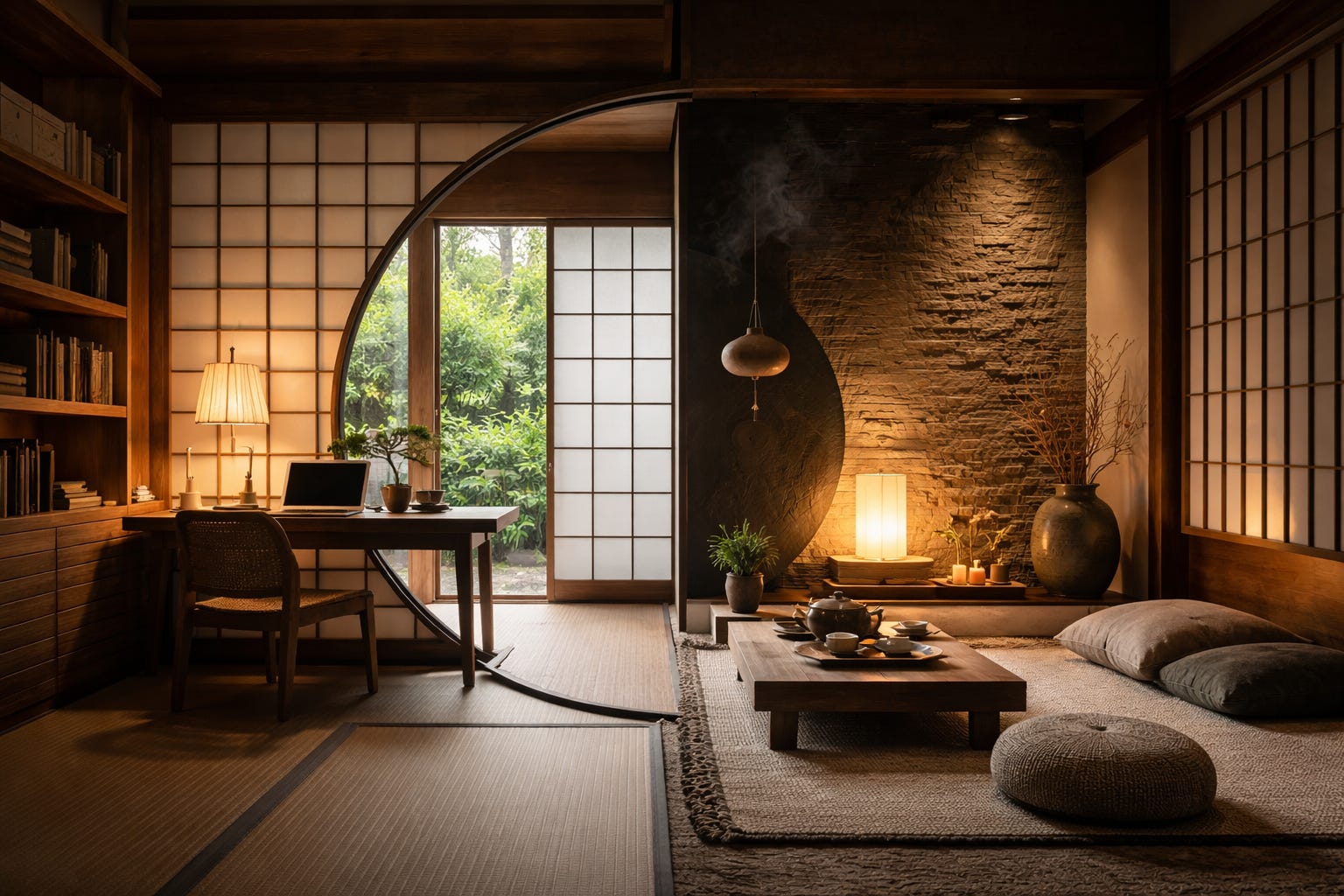
created with AI assistance for The Earth & Flame
In traditional Japanese culture, balance is not simply decorative. It is fundamental. Nowhere is this more evident than in the home.
Modern households are increasingly expected to serve as office, classroom, therapy space, kitchen, studio and sanctuary. The demand for energetic balance has never been greater. At the centre of this need is in-yo, the Japanese principle of duality, drawn from the same Taoist roots as yin and yang.
This is not minimalism. It is not about creating a quiet aesthetic. It is the purposeful arrangement of space to regulate rhythm, mood and attention.
Yin and Yang In the Modern Household
In-yo refers to the interaction of opposing yet complementary forces.
Yin (in) is soft, dark, cool, quiet and internal.
Yang (yo) is bright, warm, active, structured and external.
Within the home, this translates into:
Yin: a corner layered with cushions, filtered light and calming scent
Yang: a kitchen mid-breakfast, a desk facing morning sun, storage with clear structure
Rather than eliminating contrast, in-yo design supports polarity. The space gains rhythm when both energies are allowed to exist and function without conflict.
Key Elements of Yin and Yang Balance
Light and shadow
Lighting should reflect the natural rhythm of the day.
Soft, indirect lighting is appropriate for sleeping areas and calm spaces. Direct or overhead lighting suits cooking areas, desks and communal working surfaces. Where natural light enters forcefully, paper shades or gauze curtains can soften it without closing it off.
Texture and containment
Rooms benefit from both softness and structure.
Cushions, throws and rugs create comfort while timber, shelving and angular lines provide visual clarity. Neither should dominate. It is the presence of contrast that creates stability.
Stillness and movement
Even in small spaces, design can direct energy.
High-traffic zones need clear walking paths. Still zones need visual permission to pause. A chair beneath a window, a mat in a corner or a low bench with nothing stored on it gives the room a place to breathe.
Sound and silence
Homes often ignore acoustic flow.
Kitchens and working zones benefit from gentle soundscapes. Bedrooms and reflective areas require quiet, which can be reinforced by fabric surfaces and soft materials. The aim is not silence but control.
Warm and cool
Temperature can ground the body as much as furniture.
Stone, tile or polished surfaces may belong in more active or external-feeling spaces. Textiles such as linen, cotton or bamboo are suited to sleeping and recovery areas. Fragrance also cues temperature such as hinoki, pine or neroli can provide cooling even in a warm climate.
Designing for Modern Life
Today’s homes must hold contradiction.
The same space may be expected to host a business meeting at 9am, calm a child’s emotions by noon and provide recovery by nightfall. It must support energy and hold silence without fracturing.
A balanced home does not erase complexity. It holds it. It allows for direction and release, focus and pause, structure and comfort. There is no need for symmetry, only for intentional division of space.
Traditional Japanese homes often model this without explanation. Open rooms are anchored by a single element: a wooden platform, a paper lantern or a mat placed just so. Even in small or temporary homes, the principle remains. Give energy somewhere to go.
Applying the Same Principle While Travelling
Hotel rooms rarely accommodate duality. They are designed for short occupancy and assumed neutrality. But neutrality is not balance. With slight adjustment, even a hotel room can hold yin and yang.
Establish zones early
Create one area for activity, the desk or a surface near light, and one for stillness. A reading chair, an unlit corner or even the far side of the bed can be made into a quiet zone. Do not allow these spaces to overlap.
Control light and scent
Use lower lighting at night. A single lamp or bathroom light is usually sufficient. A familiar oil or balm in the evening helps the nervous system recognise the shift from motion to rest.
Consider temperature and noise
Turn down the thermostat at night. Use the fan setting or a white noise app to reduce ambient noise. If the room echoes, a shawl or scarf over a surface can mute it.
Soften the structure where needed
If the room is cold or clinical, layer something soft at the foot of the bed. Sit upright when working. Lie flat when resting. The posture and surface inform the body as much as the task does.
A balanced home is not necessarily calm. It is responsive. It reflects the real conditions of life while allowing the people within it to move between energy states without tension.
Yin and yang are not meant to blend into grey. They are designed to co-exist with clarity. Whether at home or away, whether hosting silence or sound, the home functions best when its flow is intentional.
This is Village Ki. A domestic system that serves the whole person, not just the surface of the space.
Travelling with children doesn’t mean shrinking your experience. It just means choosing cities that refuse to split joy into age brackets.
These destinations make space for all of it. Lanterns and music. Festivals and family dinners. Culture without compromise.
For those navigating the world as single parents or entrepreneurial travellers, I’ve begun mapping itineraries, guides and curated lists that lean into calm, curated, luxury experiences. You can find them in the Shoppe or by following the link to the website.
Enjoyed the ride? Share this piece with a fellow traveller!
You Might Also Like
For readers living within intentional households: how is balance created through design? Are softness and structure given space to coexist? Share how the home supports daily rhythm, recovery and work. Contributions are welcome below.
If your property or experience champions culture and the quiet art of hospitality, I welcome conversation. The Earth & Flame collaborates with hotels and services that support intentional travel and uphold the standards of discreet, private-club level hospitality, with coverage created on location through itineraries, guides and editorial features.
Work With Me
The Earth & Flame collaborates with private clubs, hotels and refined travel services that value culture, discretion and the quiet art of hospitality. Coverage is created on location through itineraries, guides and editorial features written through the lens of Luxury Single Parent Travel and global entrepreneurial life. Each partnership is shaped with intention and respect for heritage, design and the experiences that make a place worth returning to.
If your property or service aligns with intentional travel and private club standards, I welcome conversation.
Enquire About Editorial Coverage

I write and global entrepreneurial life. Work spans food, heritage, design and the rhythm of intentional living, with a focus on places and experiences that honour craft and character. From farm-to-table traditions and world coffee culture to destinations that support refined family travel, each feature is approached with curiosity and depth.
For properties that align with private club standards and thoughtful travel, or for stories that honour intention and elegance are always worth a conversation.
Thanks for reading and being part of The Earth & Flame!